
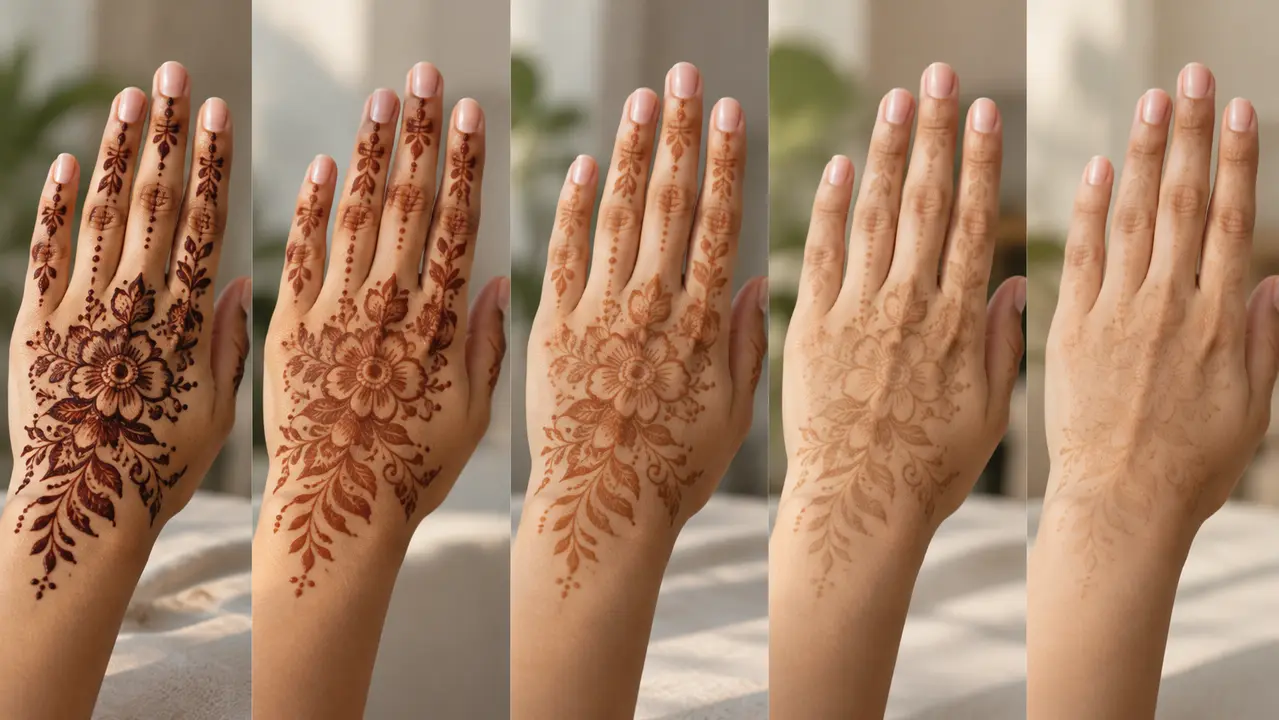
Henna tattoo duration: why it varies, which areas retain colour better and how to understand the way your design changes.
Contents
- What you need to know before counting the days
- The body area makes a big difference
- A design goes through three stages
- What makes a design fade faster
- Planning for durability without miracle recipes
- When to choose a different design rather than longer wear
- A visual timeline for planning a celebration
What you need to know before counting the days
The lifespan of a henna design varies. An estimate ranging from a few days to around two weeks is often given for visible natural staining, sometimes longer depending on the body area and circumstances, but nobody can guarantee a precise schedule for every skin type. The important distinction is between how long the pigment remains present and how long the design retains enough contrast to be noticeable.
A design that starts out light may become almost invisible quickly, while a stronger design remains legible even after fading begins. This is not necessarily a difference in henna quality: the visual effect matters as much as any residual colour.
The body area makes a big difference
The palms and soles often develop intense stains. The backs of the hands, wrists and arms frequently produce softer results. Yet an area that stains well may also experience a great deal of friction: the palm, for example, is used and washed throughout the day.
That is why these tendencies should not be turned into a chart of “guaranteed” durations for each body part. Two people wearing exactly the same design may find it fades at different rates depending on their daily habits.
A design goes through three stages
On removal: the colour may be relatively pale and orange if you use a natural preparation. During development: it changes over the following hours. During fading: the outlines gradually lose contrast as the skin's surface renews itself. Understanding this sequence matters when planning photographs or an event.
If you want to show your design at a wedding or party, allow for the development time stated for the preparation. Applying it too late may not produce the desired effect in the first photographs, even if the drawing itself is technically successful.
Remember: before trusting a promise or a photograph, always check what kind of product it is and what you want the design to achieve.
What makes a design fade faster
Frequent washing, rubbing, exfoliating products and activities involving the decorated area can speed up the loss of visibility. You do not need to sacrifice hygiene to preserve a design: simply remember that a temporary tattoo is not permanent and will change with everyday life.
On hands, friction from clothing and washing habits differs from person to person. On feet, contact with shoes and socks can also affect how the design looks. A friend's experience is therefore not a reliable prediction of yours.
Planning for durability without miracle recipes
Choose a product suited to your goal, follow its instructions and plan its use around the occasion. Avoid harsh or irritating tricks intended to “fix” the colour at any cost. Adding lemon or essential oils without knowing the formula may not suit the skin or product. Final durability cannot be predicted from any one trick.
If you want to improve the initial staining, the guide “Why is my henna not staining?” covers that question. Here, we focus on the normal ageing of a successfully applied design.
When to choose a different design rather than longer wear
A very fine design may become visually indistinct more quickly than one with broader lines simply because the contrast becomes harder to perceive. If you want a composition to remain legible for several days, consider the line thickness and level of detail that suit your project.
Sometimes changing the placement or simplifying the motif is a better answer than buying a succession of products promising exceptional durability. This is a practical aesthetic choice, not a biological guarantee.
A visual timeline for planning a celebration
Imagine a design intended to be photographed on Saturday. The aim is not automatically to apply the henna on Friday evening, but to understand the development time of the product you have chosen. With a natural henna preparation, the appearance may change after removal; a surface-applied cosmetic decoration has different requirements.
Try it beforehand with a small design, taking a photograph each day. This will give you a more personal reference than a standard chart promising fifteen guaranteed days. The experience will help you choose both the application day and your expected colour.
Factors that change how long a design lasts
| Factor | Possible effect | What to remember |
|---|---|---|
| Body area | Variable staining intensity | Palm and arm do not look the same |
| Washing and rubbing | Faster visible wear | Normal hygiene remains essential |
| Initial intensity | More or less noticeable contrast | Visibility and presence of pigment are not identical |
| Type of preparation | Different result and removal | Do not confuse plant-based henna with surface decoration |
Frequently asked questions
How many days does natural henna last?
Often several days, sometimes around one to two weeks; results vary considerably.
Does henna last longer on feet?
Some areas of the feet stain strongly, but shoes and friction also affect visibility.
Does a very dark colour always last longer?
It may remain visible for longer without guaranteeing that the stain itself is physically longer-lasting.
Does the design disappear all at once?
No. It generally fades gradually.
Can fifteen days be guaranteed?
No. Such a promise ignores differences in skin and everyday use.
Further reading
Sources and references
- Kew — https://powo.science.kew.org/ (for relevant background; not to be interpreted as commercial endorsement)
- FDA — https://www.fda.gov/cosmetics/cosmetic-products/temporary-tattoos-hennamehndi-and-black-henna-fact-sheet (for relevant background; not to be interpreted as commercial endorsement)