
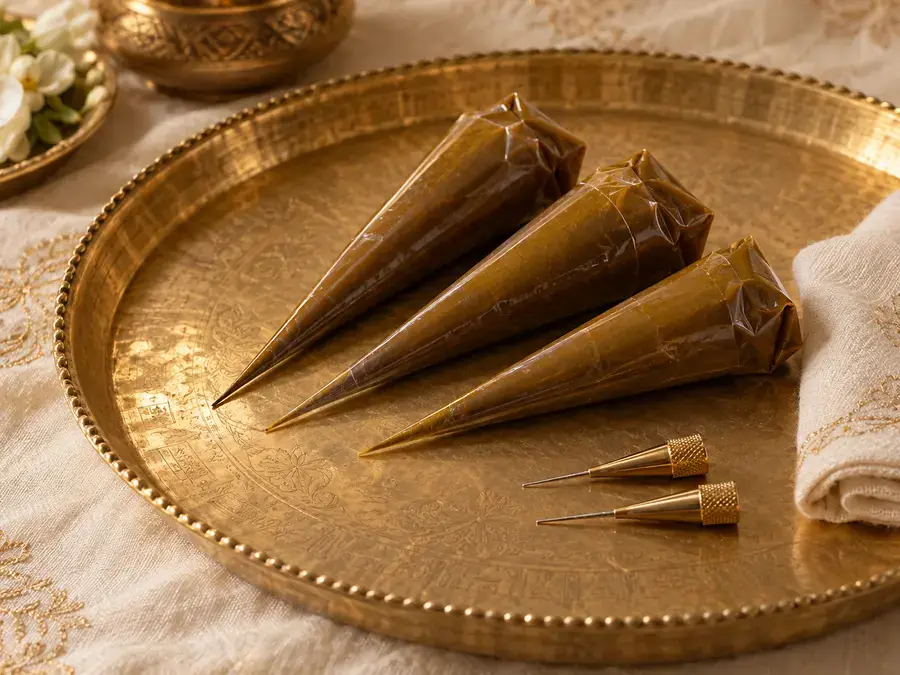
You may have seen the letters “BAQ” printed on a packet of henna powder, alongside appealing promises: exceptional fineness, superior quality, intricate designs and intense colour. On some product pages, it almost looks like an official quality mark. Yet those three letters don't fully answer the question “Is this henna any good?” You need to learn to distinguish marketing language from characteristics you can actually verify.
The short answer: BAQ generally stands for Body Art Quality. In the henna trade, the phrase refers to powder marketed as suitable for drawing on the skin. It is not, in itself, an official certification or an independent analysis of the ingredients.
What BAQ means — and why it isn't a qualification
The abbreviation became widespread in discussions about mehndi, particularly to distinguish powders intended for precise line work from some powders sold primarily for other purposes. It provides a useful shorthand: when a powder is labelled BAQ, the manufacturer or retailer is suggesting that it meets the needs of henna artists.
But a term used by sellers doesn't automatically have the status of a standard. For a certification to count as evidence, you need to know who issues it, according to which criteria, using which methods, and for which batches. The BAQ label alone doesn't answer these questions. A circular logo or professional-looking typography makes no difference: the appearance of the packaging does not guarantee that any particular checks have been carried out.
That doesn't mean all BAQ powders are bad or that the term is useless. It means that BAQ can be an initial indication of intended use, but never the final deciding factor.
What quality “for drawing” actually involves
Imagine drawing a flower stem and then placing ten tiny dots along it. The paste needs to flow from the applicator without interruption. Poorly ground or uneven plant material makes this more difficult. Fineness and consistency are therefore useful qualities for body art.
Composition is another matter. Powder made from Lawsonia inermis leaves is not the same as a blend of plants, pigments and other ingredients. Stating the botanical species helps identify what is being sold. Finally, storage conditions and traceability provide useful information about how the product has been preserved and tracked.
These criteria complement one another. A very fine powder hasn't necessarily been stored better; a well-documented packet isn't necessarily easier to apply; and a known origin doesn't fully describe composition. You therefore need to consider several indicators together.
“Sifted seven times”: useful information, but with limits
Claims about repeated sifting are common. The principle is straightforward: removing oversized fragments helps create a smooth paste. This meets a genuine requirement in mehndi art.
However, “sifted seven times” does not enable a scientific comparison between two powders when you don't know the sieve mesh sizes, the procedure or the final particle size. Seven passes through one sieve aren't necessarily better than three through a finer one. Nor does the figure measure dye content.
Good to know: a powder may be perfectly suitable for drawing without advertising numerous rounds of sifting. The reverse is also possible: an impressive figure may be impossible for a customer to verify.
BAQ, natural and pure: three ideas that must be kept separate
A packet may display all three expressions, but they don't answer the same question.
| Claim | What it suggests | What it does not establish |
|---|---|---|
| BAQ | Intended for skin designs | Independent certification or automatic compliance |
| Natural | Emphasis on plant origin | Guaranteed safety or fully known composition |
| Pure | Presented as an unmixed product | Proven absence of impurities without documented testing |
| Sifted several times | Aim of achieving more uniform particle size | Measured particle size or guaranteed colour |
| Geographical origin | Declared growing or processing location | Identical quality across all batches |
This table helps you interpret claims; it is not a ranking of manufacturers. To tell products apart, examine the entire label and ask for clarification when necessary.
The five most useful questions to ask before buying
1. What exactly is the raw material? Look for Lawsonia inermis, rather than just a fanciful product name. Botanical identification doesn't eliminate the need for a clear ingredient list.
2. Is it a powder or an already-mixed preparation? Different information matters in each case. Ready-to-use paste may contain additional ingredients.
3. What is the product intended for? Even a very fine powder sold for hair shouldn't be assumed suitable for application to the skin.
4. What storage and batch information is provided? These details don't prove quality on their own, but they show whether the product can be identified and traced.
5. Does the retailer answer questions precisely? A documented answer is more useful than a “world's best henna” promise. If you ask about ingredients and the only answer is “100% premium”, you still haven't received the information you wanted.
You can save these questions on your phone before ordering. They work for other plant-based products too: looking for evidence rather than superlatives is always a sensible habit.
Example: two product pages, two levels of information
The first displays “Authentic BAQ, extraordinary colour, ultra-premium”, accompanied by a flattering photograph. It doesn't specify ingredients, intended use or a batch. The second is less dramatic but clearly states what's in the packet, the intended use, storage information and how to contact the seller. You still don't know which one will give better results when drawing, but the second allows a more informed decision.
The point isn't to choose the second blindly. It's to avoid confusing the number of promises with the amount of evidence. In a field as visual as henna, that distinction matters particularly strongly.
What to remember when placing your first order
BAQ is a useful term for understanding the henna market. Don't treat it as a universal guarantee. When comparing two powders, return to tangible criteria: identifiable composition, stated intended use, relevant fineness, storage, traceability and the quality of the seller's answers.
For a fuller comparison of powder characteristics, read “Henna Powder: How Can You Recognise Good Quality?”. To understand geographical labels such as Rajasthan, Sojat and Morocco, a separate guide explains what origin can — and cannot — tell you.
FAQ
Does BAQ mean “organic”?
No. “Body Art Quality” does not mean “organic”. Any organic certification would have to be separate and verifiable against its own standard.
Is it a European certification?
No. The letters BAQ alone do not refer to an official European certification. Always ask exactly what checks are being claimed.
Does BAQ powder always produce a darker colour?
No. The result depends, among other things, on preparation and conditions of use. The abbreviation is not a measurement of colouring strength.
Can BAQ powder be used on hair?
The intended use and the manufacturer's instructions must be checked. BAQ alone does not establish suitability for every purpose.
Why do some packets say “sifted seven times”?
It's a way of highlighting the sifting process. Without a published method, the figure is not enough to compare the fineness of two products objectively.
Sources and references
- Kew Science, botanical identity of Lawsonia inermis: https://powo.science.kew.org/taxon/urn%3Alsid%3Aipni.org%3Anames%3A553638-1/general-information
- Kew Science, Lawsonia inermis: https://powo.science.kew.org/taxon/urn%3Alsid%3Aipni.org%3Anames%3A553638-1/general-information
- FDA, henna/mehndi products, ingredients and added dyes (US regulatory context): https://www.fda.gov/cosmetics/cosmetic-products/temporary-tattoos-hennamehndi-and-black-henna-fact-sheet
Editorial note: the commercial meaning of BAQ described here is not a definition provided by Kew or the FDA; do not attribute this point to either organisation.