
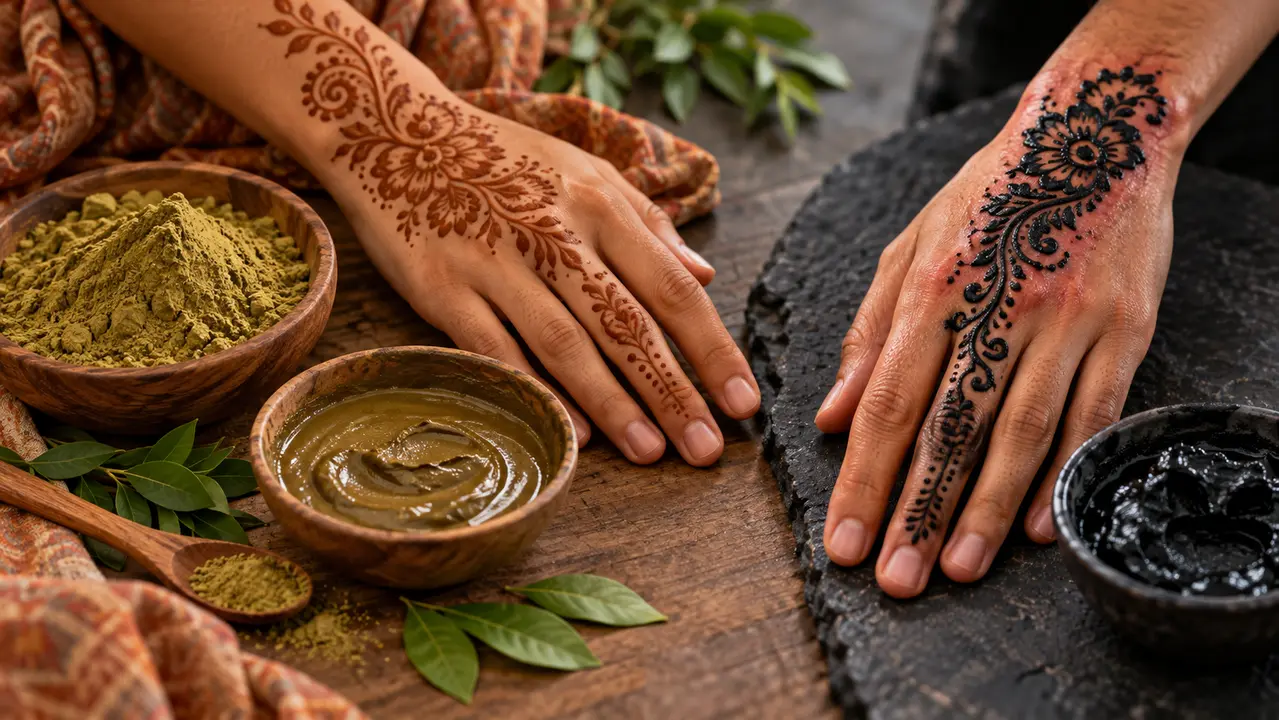
Black henna does not have one single formula. Discover why composition matters and how to choose a product suitable for skin.
Contents
- Black is not a diagnosis
- Where does black henna's reputation come from?
- What “PPD-free” means
- Choosing a black effect: three comparison points
- The role of a specialist shop
- What matters most: choosing the right design
- An example of responsible comparison
Black is not a diagnosis
A black design can be elegant, graphic and highly visible. That does not mean every black product is dangerous. Nor does the term “black henna” identify one specific ingredient. The distinction matters: natural henna from Lawsonia inermis stains skin in shades ranging from orange to reddish-brown; manufacturers may use other components to achieve a different appearance.
The real question is therefore not whether one colour is “good” and another “bad”. It is what the preparation actually contains. A specialist shop that clearly communicates its formula offers a more solid basis for choosing than a reassuring but unverifiable marketing claim.
Where does black henna's reputation come from?
Sometimes severe skin reactions have been reported after temporary tattoos described as “black henna”. PPD is among the ingredients implicated in cases documented by health authorities. These reports must be taken seriously without extending them to every black preparation. Publicly available data do not allow a simple calculation of a reaction rate representative of all consumers.
There are also accounts of homemade mixtures containing various substances. Without laboratory analyses linked to the cases in question, it would be imprudent to claim that lime or cement explains most reactions. The useful distinction is this: the history of certain products justifies checking the current formula of the one you intend to apply.
What “PPD-free” means
“PPD-free” means the product is presented as not containing paraphenylenediamine. This is relevant information, particularly given the reactions documented with that ingredient. However, it is not a universal safety certificate: other colourants, preservatives or components may be present, and suitability for the stated skin application must be established.
When comparing two black products, do not stop at the manufacturer's name, a “long-lasting” promise or an absence of negative reviews. Instead, look for the label, directions for use and information about the formulation. This is more useful than a list of brands presented as automatically harmless.
Remember: before trusting a promise or a photograph, always check what kind of product it is and what you want the design to achieve.
Choosing a black effect: three comparison points
Appearance: do you want fine lines resembling a graphic tattoo or a highly contrasting temporary decoration? Behaviour: does the product stain the skin or sit on its surface as makeup, to be removed differently? Formula: are the ingredients suitable for the stated use and explained clearly? These three questions prevent you from treating products as identical simply because they share a colour.
A black cosmetic product can look beautiful without functioning like traditional henna. Knowing this before purchasing is an advantage: you can choose according to how you want to wear the design, not just the intensity of an advertising photograph.
The role of a specialist shop
A responsible seller presents the exact product reference, usage instructions, available ingredient information and storage conditions. They answer questions without certifying that nobody will ever have a reaction. Before recommending a specific product, we need to be able to check its current listing; we will not assume that a Golecha, Amina or other branded product has the same formula as an older version.
You can browse OrientalDiscount's henna selection to discover products, bearing in mind that Hennediscount has a commercial relationship with OrientalDiscount. This commercial referral is not health and safety approval. Compare each listing and request further information if necessary.
What matters most: choosing the right design
Black is particularly striking for minimalist motifs, sequences of geometric lines or evening designs. However, you need to consider how the formulation behaves on skin: a surface finish and a stain are not interchangeable. Before an important occasion, it is better to understand the product and its application time than to discover how it works on the day itself.
Natural reddish-brown henna offers a different aesthetic, often chosen for traditional mehndi compositions. Both approaches may appeal for different reasons. Our role is to help you identify a suitable formula and then find a design that brings out the colour.
An example of responsible comparison
Imagine two cones both labelled “black”. The first specifies its ingredients, intended use and removal method. The second merely says “professional, intense, guaranteed”, with no further information. Even if both photographs are appealing, you have better information for understanding the first product. This cannot guarantee it will suit every skin type, but it represents genuine progress in making a choice.
On an editorial page, a comparison chart should therefore contain fields such as “ingredients disclosed”, “skin use indicated” and “removal method”. It must never invent a safety score out of five or declare one brand superior without verifiable data.
Frequently asked questions
Does black henna exist naturally?
Lawsonia inermis powder alone does not produce a true black stain on skin. Black products use other formulations.
Is all black henna dangerous?
No. That would be an overgeneralisation. The formulation and intended use must be examined.
Does PPD-free mean risk-free?
No. It provides useful information about one ingredient, not a universal guarantee.
Can PPD be identified by sight?
No. An intense colour is not a chemical analysis.
Can an entire brand be recommended?
Not without knowing the precise formulas of its current products.
Further reading
Sources and references
- FDA — https://www.fda.gov/cosmetics/cosmetic-products/temporary-tattoos-hennamehndi-and-black-henna-fact-sheet (for relevant background; not to be interpreted as commercial endorsement)
- NHS — https://www.nhs.uk/conditions/hair-dye-reactions/ (for relevant background; not to be interpreted as commercial endorsement)
- Kew — https://powo.science.kew.org/ (for relevant background; not to be interpreted as commercial endorsement)