
White bridal henna: designs, placement, appearance on skin and ideas for creating elegant decoration.
Contents
- The secret of white henna: it is not the same kind of staining
- Why the lace effect works so well
- Six compositions for a bride
- Wedding, party, photo shoot: adapting how long the design lasts
- Culture as inspiration, not cliché
- Where to find a suitable preparation
- Details that make all the difference in photographs
The secret of white henna: it is not the same kind of staining
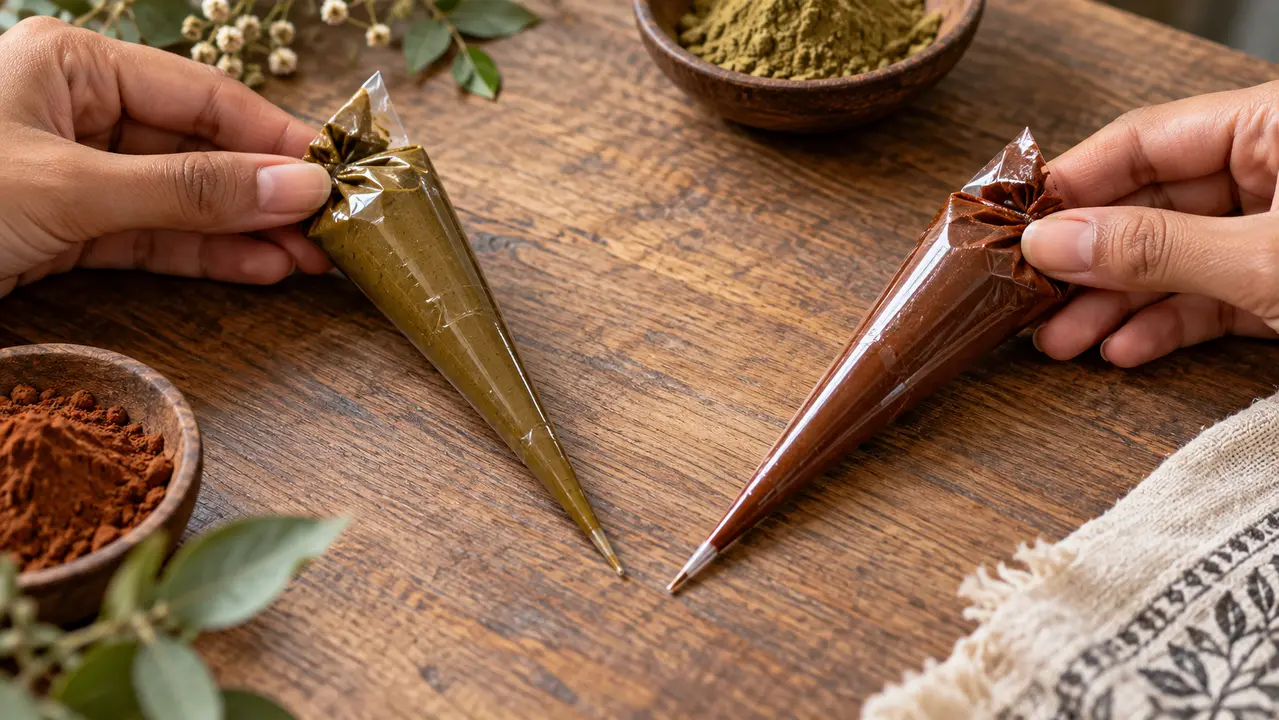
White henna creates a luminous lace effect that stands out particularly well in wedding photographs. The name is common, but it can be misleading: Lawsonia inermis powder does not naturally stain skin white. Products known as “white henna” are generally surface-applied cosmetics, behaving differently from reddish-brown plant-based henna.
This does not make them any less attractive. It simply helps you choose the right product and plan its use: some formulas create a design that remains visible throughout an event, while plant-based henna leaves a stain that evolves over several days. Always read what the manufacturer specifies.
Why the lace effect works so well
White catches the light and accentuates delicate lines. On a hand, petals surrounded by bare skin resemble embroidery resting on the skin. The effect is often more elegant when it stays light. A design filled entirely with white can lose the detail that makes it appealing, especially in close-up photographs.
When planning a motif, imagine the path your eye will follow: starting at the wrist, crossing the back of the hand and reaching one or two fingers. This continuity turns several small elements into one coherent design. It can evoke lace gloves without having to cover every inch of skin.
Six compositions for a bride
Floral cuff: a border around the wrist that opens towards a central flower. Openwork glove: a network of fine lines connecting wrist and fingers, leaving plenty of open space. Diagonal branch: a flowering stem following the hand. Finger rings: white jewellery-like details. Ceremonial rosette: a decorative circle with a few leaves. Contemporary asymmetry: one hand more elaborately decorated, the other more understated.
A beautiful composition works with the dress, jewellery and type of ceremony. Long sleeves may conceal part of the wrist; a large ring may hide a rosette on the ring finger. Try out the placement before choosing the final design.
Remember: before trusting a promise or a photograph, always check what kind of product it is and what you want the design to achieve.
Wedding, party, photo shoot: adapting how long the design lasts
The product type determines application time, drying, the possibility of transfer onto fabric and how it is removed. White body makeup does not necessarily react like plant paste: advice about natural henna staining times should not be applied to it automatically. One formula may require avoiding friction, while another may need to dry completely.
For an event, plan the application according to those instructions and when the bride needs to get dressed. Check how the finish will work with planned activities, especially exchanging rings and photographing hands. A trial with a small design is often more useful than a universal promise about durability.
Culture as inspiration, not cliché
In some families, a henna evening forms part of wedding preparations. However, rituals, guests and aesthetic customs differ between regions and family histories. White decoration in contemporary use should not be portrayed as a universal ancient tradition or religious obligation. It is an aesthetic option that can draw on cultural references.
A bride-to-be may prefer the brown of plant-based henna, white decoration or no design at all. What matters is choosing what feels right for her and respects the meaning she wants to give the celebration.
Where to find a suitable preparation
For white decoration, look for a product explicitly intended for that use on skin, with an available ingredient list and instructions. The listing for the ready-to-use white henna cone sold by OrientalDiscount is one option to examine before buying; Hennediscount has a commercial relationship with this seller. Do not confuse a marketing name with proof of compliance.
Whatever you choose, follow the same compositional principle: a beautiful clean line, thoughtfully planned spaces and a coherent pairing with jewellery often create a stronger effect than covering a large area with patterns.
Details that make all the difference in photographs
A white design needs carefully managed contrast. In a wedding photograph, very strong light may wash out fine lines, while a cluttered background distracts the eye. Consider a few close-up shots of the hand beside the bouquet, soft side lighting and a pose that gives the fingers room. The dress, jewellery and flowers already provide rich decoration: the design need not cover everything.
Also ask for a photograph showing both hands together before deciding on pronounced asymmetry. A motif that looks magnificent on its own can sometimes make the overall composition feel unbalanced when the hands are side by side.
Frequently asked questions
Can plant-based henna stain skin white?
No. The white effect comes from a different decorative preparation.
Does white henna last as long?
Not necessarily. Durability depends on the formula, often a surface product, and its instructions.
Which designs work for a wedding?
Flowers, bracelets, openwork lace effects and asymmetrical compositions work well.
Can it be combined with jewellery?
Yes, by leaving open spaces so rings and bracelets do not conceal the design.
Is it a mandatory religious ritual?
No. Aesthetic choices vary between families and traditions.
Further reading
Sources and references
- UNESCO — https://ich.unesco.org/en/RL/henna-rituals-aesthetic-and-social-practices-02116 (for relevant background; not to be interpreted as commercial endorsement)
- Kew — https://powo.science.kew.org/ (for relevant background; not to be interpreted as commercial endorsement)