
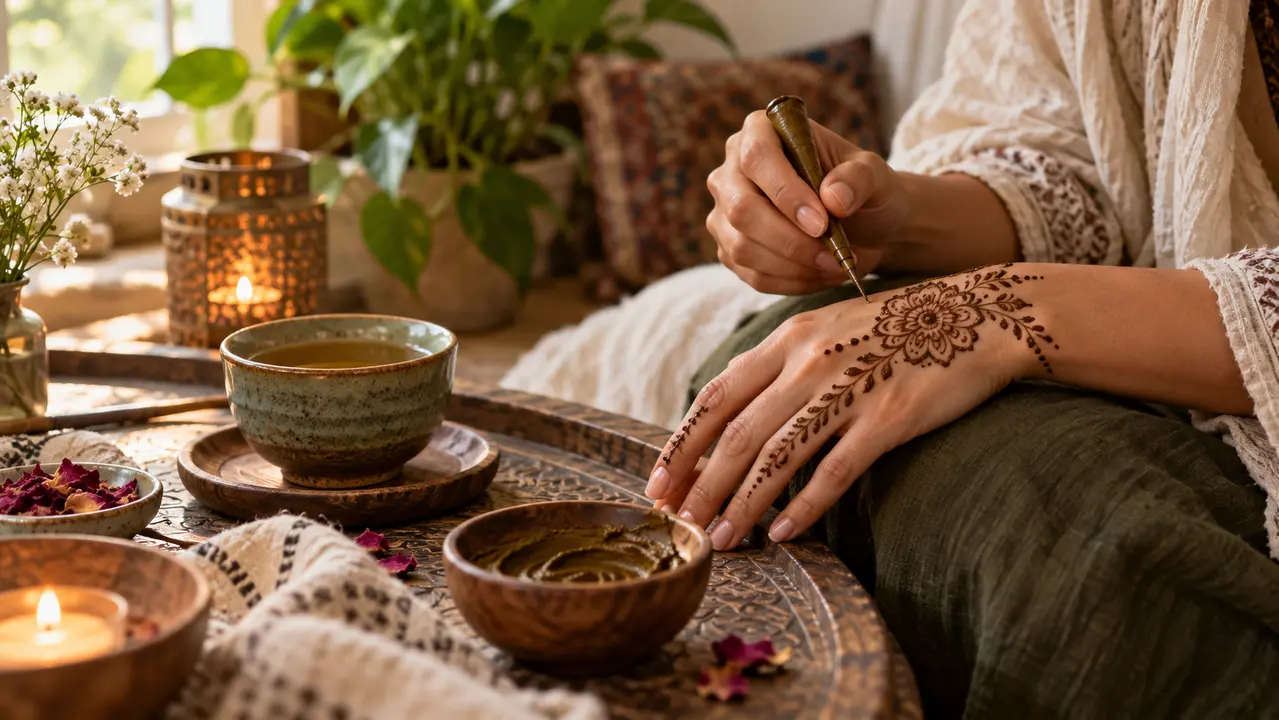
Discover henna as a creative activity and shared experience, without confusing tradition, aesthetics and proven medical benefits.
Contents
- Why a beauty ritual can feel good
- The senses and movements involved in a session
- Henna as a shared skill
- Skin, hair and health: avoiding confusion
- Organising an enjoyable time around henna
- Enjoying yourself without looking for extraordinary benefits
- Three ways to approach henna according to your interests
Why a beauty ritual can feel good
Taking time to draw, choose a design for inspiration and share a session with people close to you can be enjoyable in itself. Henna has a place in celebrations and the passing on of traditions. This pleasure does not require claiming that the plant treats stress: a calm, creative activity can simply offer a moment to slow down and focus on a task.
A small flower drawn on the hand can then bring back memories of the session for several days. For some people, it is a way to preserve a memory of a holiday, wedding or afternoon with friends. The experience is personal: there is no identical psychological effect guaranteed for everyone.
The senses and movements involved in a session
Choosing the design, feeling the paste's texture, drawing precisely and waiting form a sequence of small steps. Each encourages attention to the present moment. For a beginner, simply practising even dots can be satisfying. You immediately notice when your movements become smoother, giving a tangible sense of progress.
The session need not be silent or meditative. In some families, on the contrary, it takes place amid lively socialising. Wellbeing can come from concentration or conviviality; neither is more “authentic” than the other.
Henna as a shared skill
Henna-related practices are passed down in many communities through gestures, conversations and observation. In 2024, UNESCO inscribed social and aesthetic practices connected with henna in several countries on its Representative List of the Intangible Cultural Heritage of Humanity. This recognition concerns a collection of practices, not a medical claim about the plant.
You can draw inspiration from this principle of passing knowledge on: ask someone close to you how they used to compose a design, compare an old family photograph with a contemporary motif, or learn a simple technique together. It is another way of giving meaning to the activity without inventing one meaning for every flower.
Remember: before trusting a promise or a photograph, always check what kind of product it is and what you want the design to achieve.
Skin, hair and health: avoiding confusion
Henna is used in some preparations intended to colour hair and others intended for body decoration. These products should not automatically be considered interchangeable. Older texts attributed treatments for burns, infections, dandruff or anxiety to henna. Such claims are too broad to repeat in a beauty guide without appropriate clinical evidence.
You can appreciate plant-based hair colouring or a decorative pattern without presenting the product as medicine. If you are seeking treatment for a skin or scalp condition, it is better to consult a healthcare professional than to replace treatment with an unevaluated traditional recipe.
Organising an enjoyable time around henna
Set up a clean table, offer a few example designs and let everyone choose a small motif. Plan an activity during the application time: music, conversation or preparations for the evening. The idea is not to impose a full treatment. Someone who does not want a design can still participate by selecting inspirations or photographing the stages.
To keep the experience pleasant, choose a preparation suited to the intended use and read its instructions. Organise the equipment to avoid staining clothes. The “henna evening with friends” guide develops the practical organisation; here, the focus is understanding the ritual's place in a beauty experience.
Enjoying yourself without looking for extraordinary benefits
The appeal of henna may be very simple: a temporary decoration, a craft hobby, a memory of an event or shared time together. You may find it relaxing, just as you might enjoy drawing, styling hair or putting together a beautiful outfit. There is no need to invent therapeutic effects for the experience to deserve attention.
This more accurate perspective also helps you make better choices: if you want to draw, focus on the design and the appropriate product. If you want to discover a tradition, read cultural sources and listen to the people who practise it. Pleasure does not need a promise of healing to be real.
Three ways to approach henna according to your interests
To learn: practise drawing a leaf and an arabesque on a suitable surface. To share: suggest an activity in which everyone selects their style and helps prepare the equipment. To discover a culture: compare accounts and documented photographs of family practices, without automatically assigning the same beliefs to every community.
These three approaches can be combined. They move beyond an overly narrow idea of “wellbeing”: it is not only a feeling of calm, but also the pleasure of developing a skill, understanding a history and freely taking part in an enjoyable social experience.
Frequently asked questions
Is henna a medicine?
No. Henna used for beauty purposes should not be presented as a treatment for illnesses.
Can you relax during a session?
Yes. Some people enjoy this creative time, but there is no guaranteed effect against stress.
Is henna for hair and skin the same?
The plant may be the same, but the products and intended uses can differ.
Why does UNESCO mention henna?
Because of the social and aesthetic practices surrounding it in different communities.
Must you follow a tradition to enjoy henna?
No. You can appreciate its decorative aspect while respecting its cultural contexts.
Further reading
Sources and references
- UNESCO — https://ich.unesco.org/en/RL/henna-rituals-aesthetic-and-social-practices-02116 (for relevant background; not to be interpreted as commercial endorsement)
- Kew — https://powo.science.kew.org/ (for relevant background; not to be interpreted as commercial endorsement)