
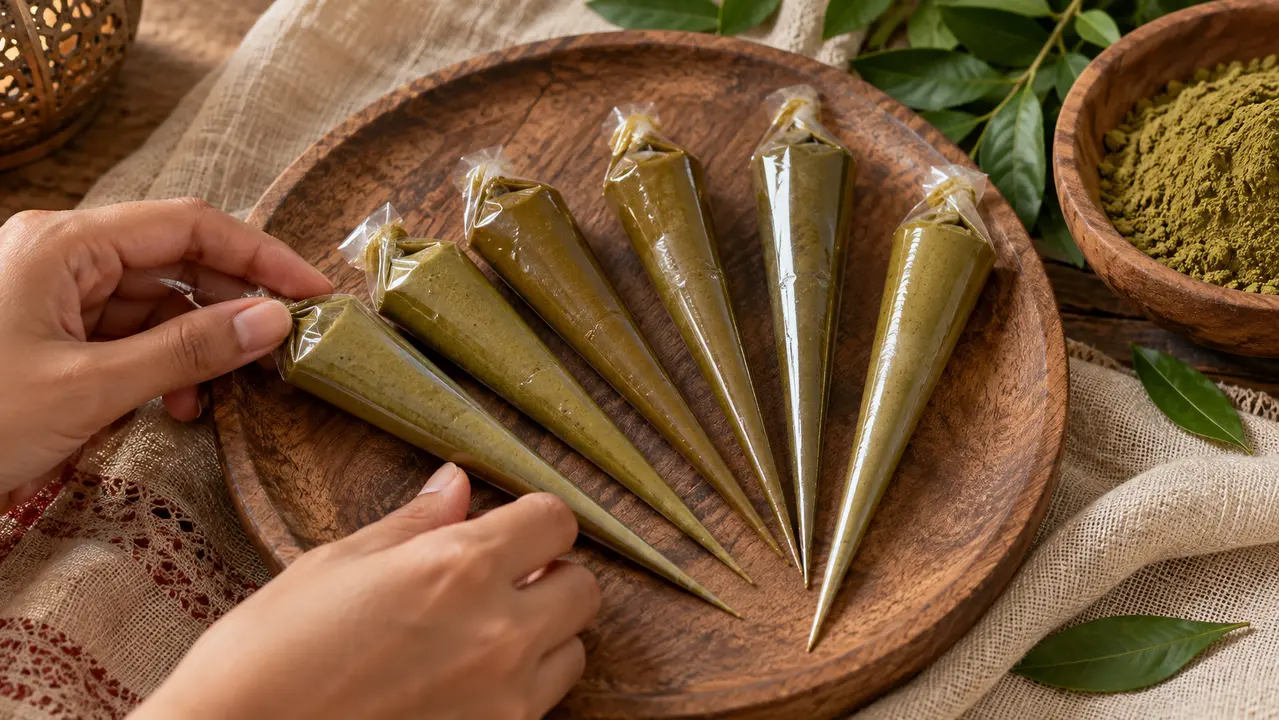
Comparing Kaveri and Golecha: advertised shades, product information, line quality, storage and choosing for your project.
Contents
- Two names, but not two single products
- Start with up-to-date product listings
- Choosing according to line quality: questions to ask yourself
- The advertised colour: promise or information?
- Comparing formats for an event
- The verdict for your project
- Performing your own fair comparison test
Two names, but not two single products
Kaveri and Golecha are often compared as though each brand had one unchanging recipe. In reality, you need to compare specific products at a given time. Products, labels and availability may change. A photograph of packaging in an old article does not establish the composition of the cone currently sold.
This guide does not claim to have conducted laboratory tests or a blind comparative trial. Instead, it provides a method for distinguishing products you can actually buy. This avoids artificial rankings and interchangeable descriptions that teach you nothing.
Start with up-to-date product listings
Look for the full commercial name, weight, ingredients, advertised shade, stated date or shelf life and storage advice on each listing. If any information is absent, do not turn that absence into an advantage or disadvantage without evidence. Contact the seller if the product interests you: a precise reply is worth more than a slogan.
The Kaveri brown and Golecha dark brown listings can be starting points for comparison, once their availability and composition have been checked. Hennediscount has a commercial relationship with OrientalDiscount.
Choosing according to line quality: questions to ask yourself
If you want to make tiny dots, a paste that flows unevenly will be difficult to control. If you are drawing a large rosette, consistency over long lines matters greatly. But no brand listing alone can guarantee fine lines. The tip, paste viscosity and the way you squeeze all influence the result.
In your first trials, draw the same small flower with each product on an appropriate surface. Observe how easy it is to open, how continuous the line is and how comfortable it feels. Compare results under similar conditions rather than reaching conclusions from a single social-media photograph.
Remember: before trusting a promise or a photograph, always check what kind of product it is and what you want the design to achieve.
The advertised colour: promise or information?
Shades described as “brown”, “dark brown” or “black” may correspond to different formulations. An advertised deeper brown does not guarantee the same result on every skin type. You should not attribute a universal colour to an entire brand, still less assume that a product labelled “natural” contains only Lawsonia inermis leaves without checking its composition.
Think instead about your visual goal: a warm traditional design or stronger graphic contrast. Then select preparations stated to be intended for that use. The final shade will always depend on several parameters and the precise formula.
Comparing formats for an event
For a few trials, choose a limited quantity. For a party, consider the number of people, average design size, session length and storage. A large batch is worthwhile only if you can use it properly. Customer reviews can provide context about ease of ordering or use, but they do not replace ingredient documentation.
A useful comparison may therefore result in two good choices: one product for learning and another for creating a larger number of designs. The aim is not always to declare a winner.
The verdict for your project
Choose Kaveri if its current product matches your desired colour, format and needs. Choose Golecha if its documented characteristics suit you better. If the available information cannot distinguish two cones, the correct verdict is “incomplete comparison”, not an invented recommendation.
This method of choosing is more honest and ultimately more practical. You come away with a list of facts to check, know what you can test yourself and understand why real differences often lie at product level rather than with the logo.
Performing your own fair comparison test
Test both applicators on the same practice surface using three identical movements: a straight line, a spiral and a dot. Observe flow consistency, the pressure needed and how easy it is to stop the line. Repeat if necessary with similarly sized tip openings. These observations remain personal, but they are more robust than a judgement based on one failed line.
This test does not compare durability on skin or composition. For those matters, consult the manufacturer's instructions and do not rely on results obtained under different conditions. A well-defined method is the real value of this head-to-head brand comparison.
An honest comparison table
| Checkpoint | Kaveri — exact product | Golecha — exact product |
|---|---|---|
| Commercial name | Record from the current listing | Record from the current listing |
| Stated suitability for skin | To be checked | To be checked |
| INCI or ingredient list | To be checked | To be checked |
| Advertised shade | Record the information | Record the information |
| Storage | Record from the instructions | Record from the instructions |
| Drawing comfort | Observe during a personal trial | Observe during a personal trial |
Frequently asked questions
Is Kaveri necessarily better for beginners?
No. It depends in particular on the exact cone, its tip and your comfort.
Does Golecha always produce a darker colour?
This has not been demonstrated as a general property of the entire brand.
Can two cones be compared on paper?
Yes, for flow and line quality, but not for predicting the exact colour on skin.
Do customer reviews replace ingredient information?
No. They can describe an experience, not certify ingredients.
Why check recent product listings?
Products and packaging may change over time.
Further reading
Sources and references
- Kew — https://powo.science.kew.org/ (for relevant background; not to be interpreted as commercial endorsement)
- FDA — https://www.fda.gov/cosmetics/cosmetic-products/temporary-tattoos-hennamehndi-and-black-henna-fact-sheet (for relevant background; not to be interpreted as commercial endorsement)