
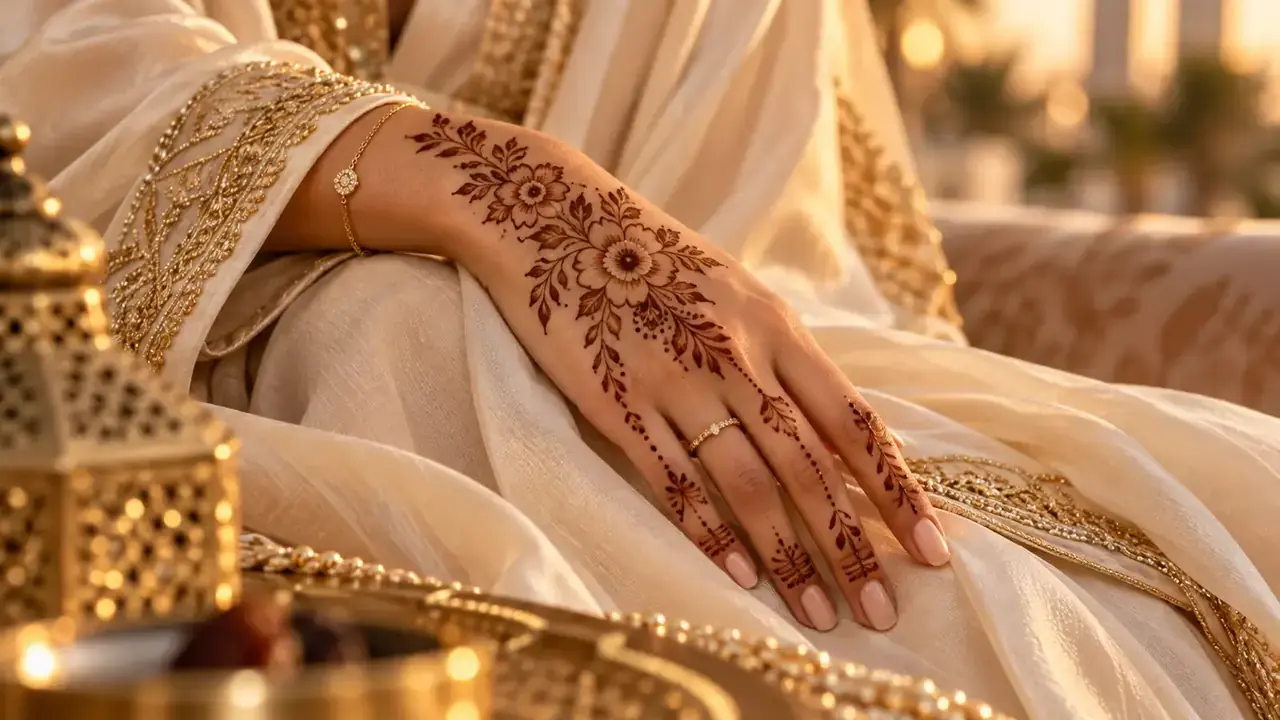
This page is a guided tour of the main families of patterns: their spirit, their shapes, their favorite places on the body and the occasions for which they are suitable. To see a complete gallery or learn how to trace the drawings, then find our dedicated guides.
The secret to a beautiful pattern: a coherent whole
When we look at a decorated hand, we first notice the design. However, its charm also comes from the spaces left free around it. A very fine line appears more delicate if it breathes; a dense pattern gains more strength when its boundaries remain clear.
Before choosing an inspiration, think about three things: the size of the pattern, the place of the design and the balance between decorated areas and visible skin.
A large design is not automatically more elegant than a small one. On the contrary, a few well-placed details can give the impression of jewelry: a branch near a finger, a frieze on the wrist or a small composition in the center of the hand.
Discreet pattern or generous composition?
A discreet pattern catches the eye up close: isolated flower, fine curve, design on a single finger. A more generous composition is seen immediately and can cover a large part of the hand. Neither is superior. It all depends on the style you are looking for and the occasion.
Floral patterns: flexible and easy to combine
Flowers are among the most famous forms of mehndi. They can be round, elongated, formed of a few petals or surrounded by leaves and small curves.
A floral arrangement often has a natural movement: the stem follows the finger, a branch rises towards the wrist, several petals adorn the back of the hand. It goes just as well with a party outfit as with an everyday outfit.
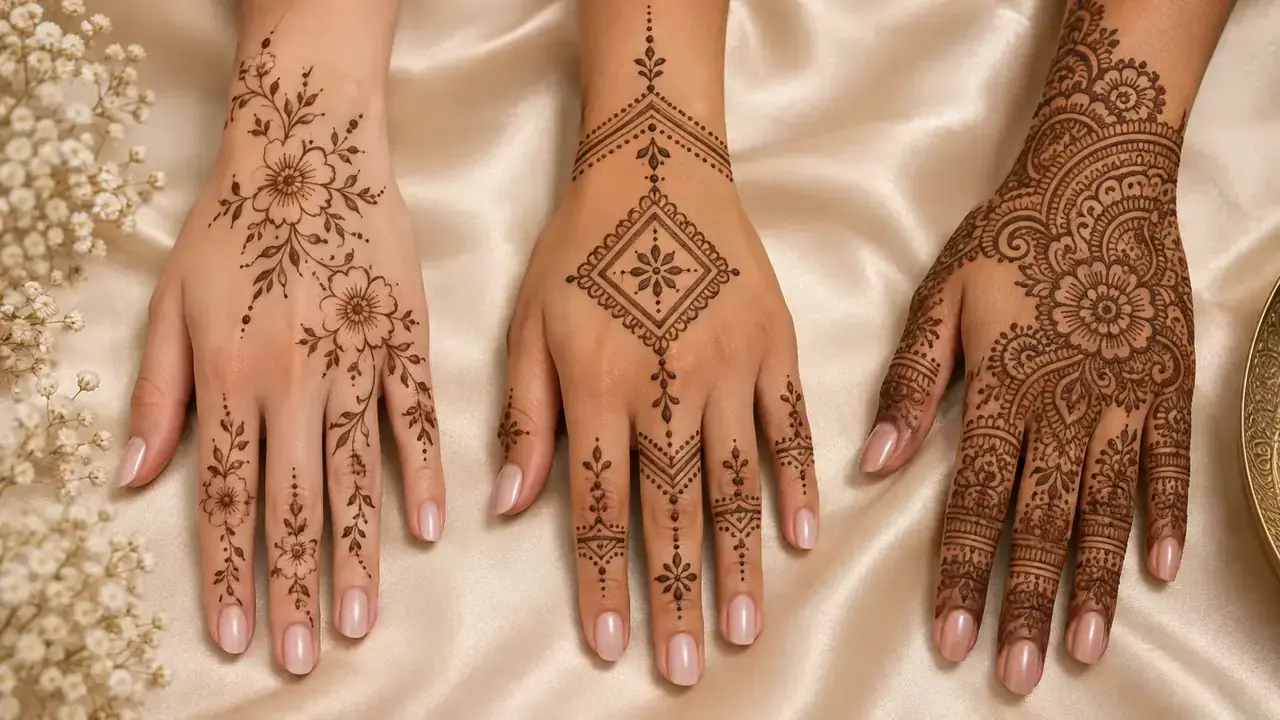
What changes everything is the amount of detail. Spaced flowers give a light result. A repetition of petals, leaves and dots can create a richer composition, perfect if you want a very decorative effect.
Inspiration idea: imagine a small branch that starts on the index finger and gently descends towards the wrist. The hand keeps free space, but the pattern follows its shape.
Geometric patterns: lines, rhythms and contrasts
Geometric designs play with angles, bands, diamonds, triangles and repetitions. Some recall decorations present in Maghreb traditions, without the same motif having the same meaning everywhere.
They can give a more graphic impression than floral designs. The repeated elements structure the hand, while the small spaces left between the shapes create rhythm.
If you like jewelry with clean lines or architectural prints, you might like this style a lot. It works particularly well on the wrist, palm or fingers.
Inspiration idea: a strip of diamonds between two thin lines can evoke a bracelet. A few points are enough to soften it, without transforming the drawing into a busy composition.
Very detailed mehndi: when each space becomes a drawing
Some Indian or Pakistani inspired creations fill almost the entire hand. There are leaves, curves, flowers, small networks of lines and sometimes patterns that echo from one hand to the other.
The beauty of these compositions lies in the overall work: we follow the drawing like a path, from a flower to a frieze, then from a frieze to another detail.
These styles are often associated with weddings and large celebrations. But they also inspire lighter, very current versions, which keep only a few elements of the traditional composition.
You don't have to like fully decorated hands to appreciate this universe. You can also choose a single mehndi detail and place it on a finger or wrist.
Contemporary style: minimalist, asymmetrical and personal
Current inspirations readily mix codes. One hand can wear a flower and the other only a small bracelet. A pattern can stop in the middle of a finger, leave part of the back of the hand bare, or follow a freer line.
This style often appeals to those who prefer discreet detail rather than a large composition. It lends itself to many desires: evening, photo session, summer, birthday or simple pleasure of changing your look.
One of the most successful ideas is to choose a single visual direction: thin curves, spaced points or a geometric frieze. Adding all the styles in a small space can make the result less readable.
Where should you place your pattern to achieve the desired effect?
On the fingers
The design becomes a detail close to a jewel. The vertical lines give an impression of elongation, while the small repeated patterns adorn the phalanges. The result catches the eye without occupying the entire hand.
On the back of the hand
This is a very visible area when you move your hands. A floral branch, a decorative circle or a composition extending from a finger to the wrist easily finds its place there. The color of natural henna may, however, be softer than on the palm.
On the palm
The natural coloring is often more intense there. It is an emblematic area of traditional compositions, especially during festivals. Patterns can be centered, symmetrical, or organized around several small shapes.
Around the wrist
The pattern may evoke a bracelet. It's an elegant way to play with friezes, flowers or dots without decorating the whole hand.
Find inspiration that truly remains yours
Looking at dozens of photos is nice, but it can also make choosing difficult. To sort out your desires, ask yourself what detail you want to highlight: the drawing itself, the shape of the hand, a particular outfit or a piece of jewelry.
Then choose a dominant family of shapes. If you prefer flowers, keep the geometric elements light. If you like clean lines, avoid filling every space with petals.
Finally, think about scale. A pattern seen in close-up on social media can look very different when it is found on an entire hand. Before you start, always look at the space it actually occupies.
Get inspired, yes; copy without thinking, no
Original creations deserve to be respected. If you publish inspiration taken from an artist, indicate her name and ask for authorization when you reuse her photo. For HenneD, the galleries must be composed of original visuals or resources whose rights are verified.
It is possible to draw inspiration from a tradition, a family of shapes or an atmosphere without exactly reproducing the work of another person.
Traditions that still inspire creation
Henna designs have traveled with families, festivals and cultural exchanges. The styles we call today “Moroccan”, “Indian”, “Gulf” or “modern” are practical benchmarks, not closed categories.
The forms change according to the artists and the regions. A flower does not have the same meaning everywhere, and certain designs are chosen primarily because they are beautiful. Let us therefore avoid attributing a universal meaning to each point or each curve.
This mix of heritage and creativity is also the charm of henna: you can discover a style, understand its context, then choose the way you want to wear it.
FAQ — Henna Designs and Inspirations
Which pattern should you choose for the first time?
A small, airy design is often easier to envisage than a composition covering the entire hand. The main thing is to choose a style that you like and that leaves room for details.
Which style seems the most discreet?
Isolated flowers, fine lines on the fingers and small bracelets often give a light look.
What is the difference between floral and geometric?
The floral plays more with curves, petals and leaves; geometric relies more on angles, bands and repetitions. The two can be combined.
Are mehndi designs always very intricate?
No. There are very detailed creations and much more airy versions.
Does a traditional motif always have a specific meaning?
No. Uses and interpretations vary according to cultures, families and artists. You should not attribute a unique meaning to each drawing.
Can you wear henna without a special occasion?
Yes. Some people wear it to parties, others just for the fun of a temporary design.