
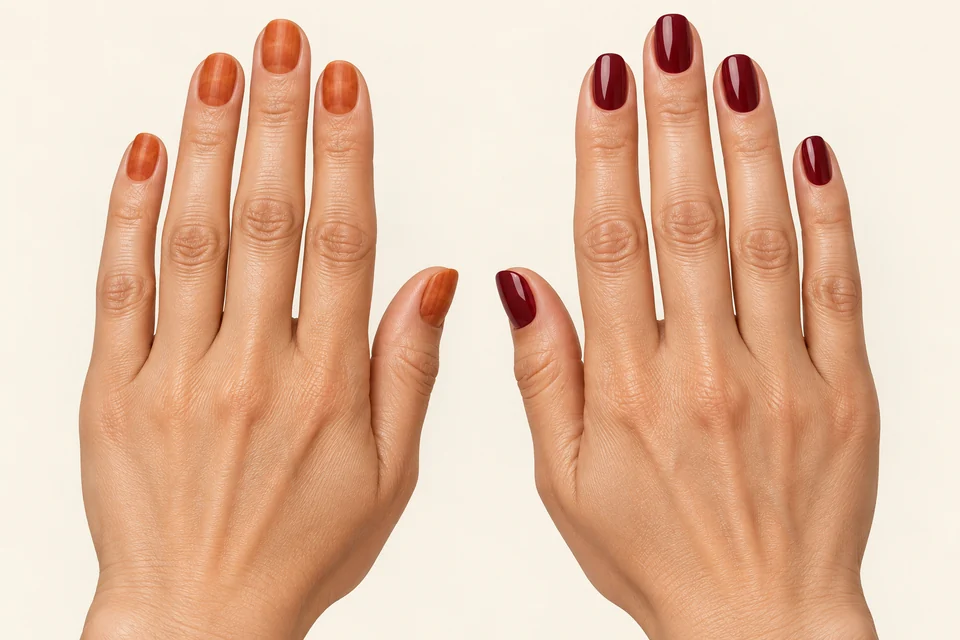
Henna on nails is a small beauty detail that can transform the look of an entire hand. A warm colour on short nails, paired with a mehndi design on the fingers, creates an understated yet carefully styled result. However, the phrase “henna for nails” often mixes together very different products and techniques: staining the nail surface, applying a decorative preparation, using a product marketed as nail polish or choosing a tinted treatment.
Before looking at colours, it is better to understand what actually remains on the nail. This is the most useful distinction when choosing a product, anticipating its appearance and avoiding confusion.
Contents
- Staining or a decorative layer?
- What colour can you expect?
- How to choose your desired result
- The question of ablution
- Mistakes to avoid
- FAQ
Staining or a decorative layer: the essential difference
Plant-based henna comes from Lawsonia inermis. Its dye can leave colour on keratin-rich materials, which explains its traditional uses on hair, nails and skin. When you remove the preparation and a colour remains, you are observing something different from ordinary nail polish, which leaves a coating on the nail's surface.
Cosmetic nail polish, by contrast, generally creates a visible film. It may be glossy, matte, transparent or coloured. That film is the desired result: it covers the nail and is removed using a method appropriate to the product. Both approaches can look attractive, but they neither feel nor behave in the same way.
There are also products marketed with names such as “henna nail polish”, “henna nail” or “nail henna”. The name alone does not tell you whether they stain the nail, leave a coating or use a different formulation. You need to read the chosen product's ingredients and instructions.
Scroll horizontally to read all columns.
| What you observe | Staining that remains after removal | Cosmetic film |
|---|---|---|
| Appearance | Colour appears to be part of the nail | Visible layer applied on top |
| Texture | Not necessarily raised after removal | Thickness or a film is often noticeable |
| Changes over time | Fades or grows out with the nail | May chip or be removed |
| Key question | Which preparation was used? | How is the layer removed? |
Key point: the word “henna” on a label does not define how a product behaves; its formula and the result after application do.
What colour can you achieve?
Traditional preparations made with pure henna produce warm shades tending towards orange and reddish brown, depending on conditions. On nails, the result can look different from the colour on the skin of the hand because the surface, thickness and contact time are not the same.
Online photographs sometimes create an illusion: a hand lit with golden light may make the colour look more coppery, while a highly contrasted photograph may deepen the appearance of brown. When choosing a shade, compare images taken in neutral lighting where possible, and make sure they genuinely correspond to the product being sold.
If you want a fully opaque, bright pink, black or glittery finish, remember that pure plant-based henna alone does not produce those effects. Other dyes or materials are involved. That alone says nothing about product quality: you need to examine the formula and its stated purpose.
Three styles that work well
Minimalist: subtle colour on short nails, without any pattern on the skin. Attention goes to the warmth of the shade rather than elaborate decoration.
Coordinated: a fine henna pattern on the fingers with a similar nail colour. The effect will look more balanced if you leave small gaps between the designs.
Festive: more noticeable nail decoration paired with a mehndi composition for an event. Remember to distinguish between the two products and their application instructions: a decorative accessory does not necessarily last as long as a stain.
How to choose the right product
Begin with one very simple question: do you want your nail to remain coloured after the preparation is removed, or do you want to wear a decorative coating for a few days? The answer will stop you comparing products that achieve different effects.
Next, examine four things: the ingredients list, application method, removal method and intended use. With staining preparations, certain substances used on hair are not necessarily suitable for nails or skin. With nail polish, the presence of a film is normal, but it may matter according to your personal preferences.
Do not try to intensify the colour by adding random extra layers or ingredients not mentioned in the instructions. If the preparation cannot deliver the result you want, the simplest solution is to choose another category of product rather than inventing a recipe.
Good to know: stained or coloured nails are not automatically “damaged” nails. However, a stain that is difficult to remove is a practical consideration to anticipate before an event or appointment.
What about ablution: what needs to be distinguished?
Some readers want to understand the difference between colour left behind by henna and a layer that might prevent water from reaching the nail during ablution. This question cannot be settled by reading “natural”, “halal” or “henna” on packaging: those words alone do not describe how a product behaves once applied.
Religious legal opinions may differ. A stain remaining after the paste is removed should be distinguished from a layer that physically prevents water from reaching the nail. For guidance on a specific religious practice, consult qualified legal sources.
Mistakes that mainly spoil the result
The first is buying something because of a keyword. “Henna” may refer to the plant, a colour, a style or a commercial product name. The second is comparing photographs taken at different times. A developing stain does not necessarily look the same as its final colour. The third is mixing up instructions: a preparation that must be removed is not handled in the same way as a film-forming nail polish.
Another, subtler mistake is forgetting that the nail's outline matters visually just as much as its surface. Even a simple, carefully chosen colour looks less neat if product spreads onto the surrounding skin. Take time to apply it cleanly and follow the instructions rather than aiming for a spectacular effect on your first attempt.
FAQ
Does henna really stain nails?
Preparations containing dyeing henna can leave colour behind, but the effect depends on the formulation and conditions of use. This must be distinguished from a product sold as decorative nail polish.
Is “henna” nail polish necessarily made from plant-based henna?
No. The name may describe a colour or a brand identity. The ingredients list and instructions tell you what kind of product you are using.
Does the colour always stay brown?
Pure plant-based henna mainly produces warm shades. Other effects may depend on additional dyes or materials; do not infer the composition from a photograph.
Is it the same as henna on the hands?
The plant may be the same, but the areas, preparations and results differ. Do not automatically reuse a product intended for hair or another part of the body.
Can you simply say it is “compatible with ablution”?
Not on the basis of a commercial name alone. You need to distinguish between staining and a possible film, then consult documented opinions relevant to the question.
Sources and references
- UNESCO, Henna: Rituals, Aesthetic and Social Practices (2024), documenting, among other things, traditional aesthetic uses on the fingers: https://ich.unesco.org/fr/RL/le-henne-rituels-pratiques-esthetiques-et-sociales-02116