
Discovering these differences allows you to appreciate henna differently. We understand better why this art has a special place in so many cultures, and how it continues to inspire current creations.
A plant, uses and a long history
Henna comes from the Lawsonia inermis plant. Its leaves are used to produce a coloring matter. Over time, this material has been used in beauty practices, body decorations and certain festivals.
Henna is found in many parts of North Africa, the Middle East and South Asia. These vast regions do not share a single culture: each includes a great diversity of languages, customs and family practices.
This is why it is better to speak of “henna traditions” in the plural. The same word can designate a very different product, decoration, moment of preparation or social event depending on the context.
Henna sometimes links gestures passed down within families and more recent creations. A person may learn from a loved one, discover a pattern at a party, then imagine their own version a few years later.
In the Maghreb: a special place in the celebrations
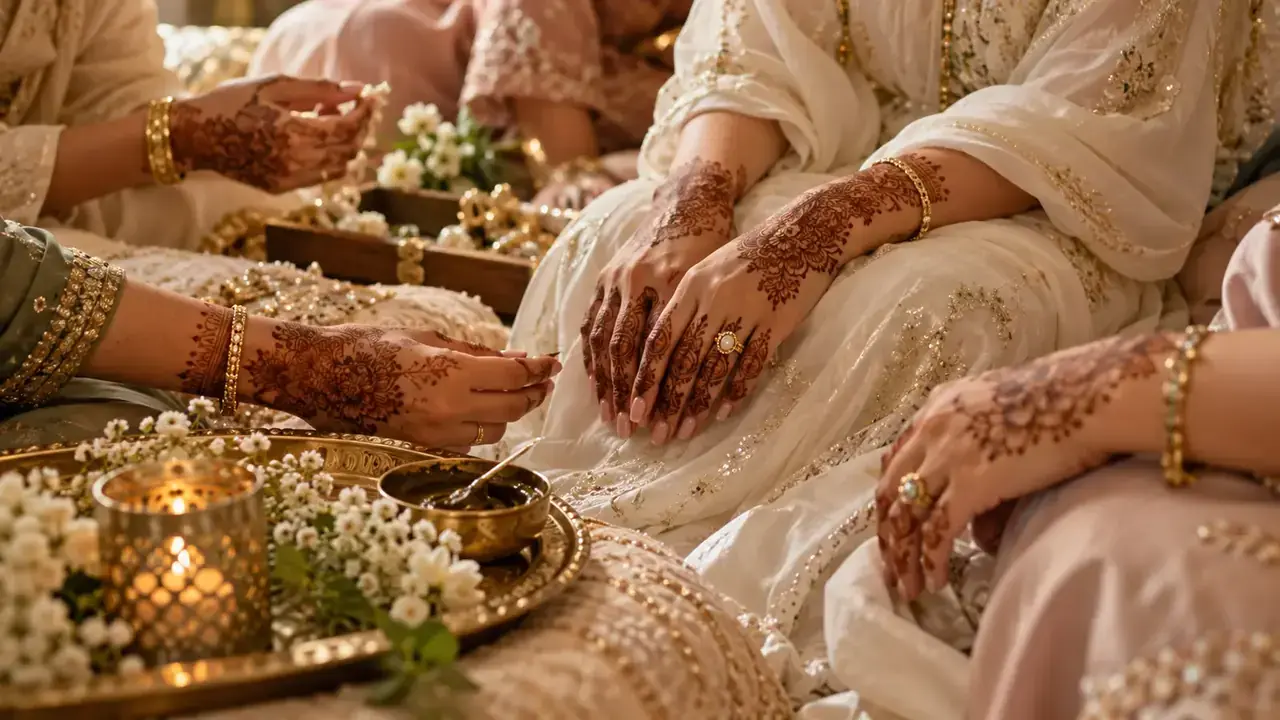
In several Maghreb countries, henna occupies a visible place during certain weddings and family celebrations. Depending on the family, we can decorate the hands, organize a moment with loved ones or combine the preparation with ceremonial clothing and jewelry.
However, it would be misleading to describe a single “Moroccan”, “Algerian” or “Tunisian” way of celebrating henna. Practices change according to regions, generations and family choices.
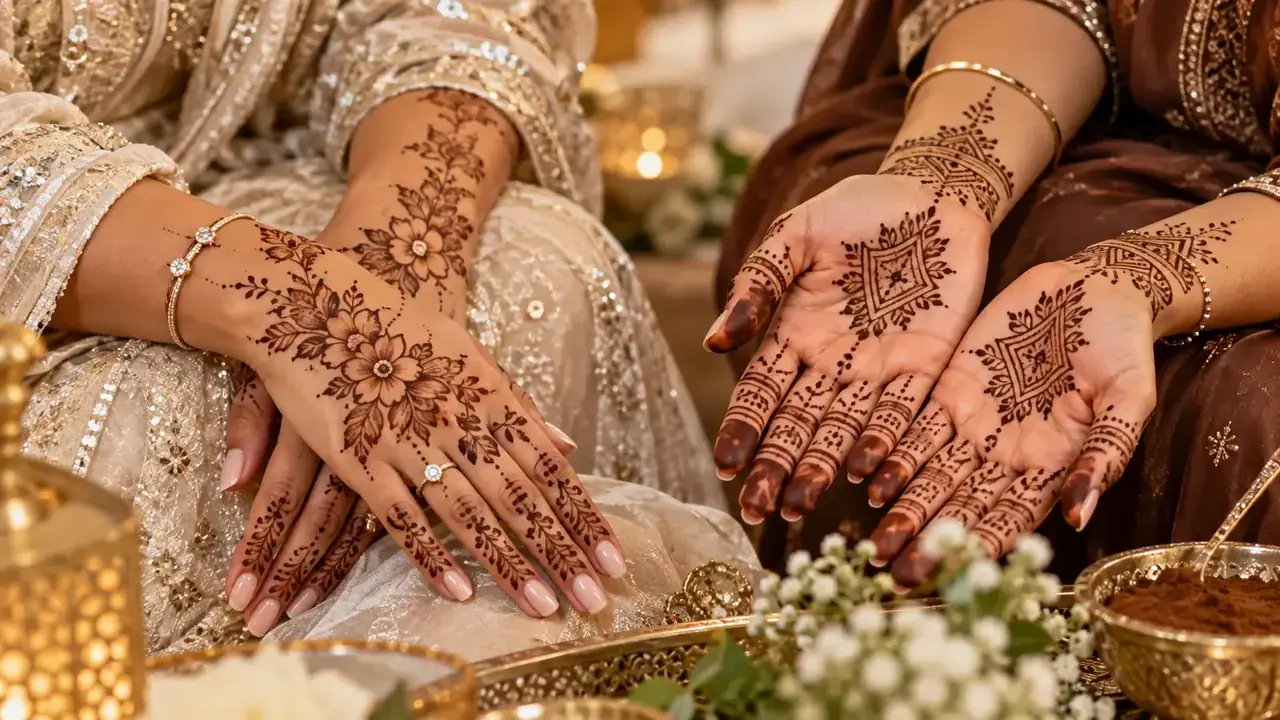
Patterns can include geometric figures, floral arrangements or more free-form designs. The style chosen does not in itself indicate a precise origin or a certain meaning.
What is often touching in these moments, beyond the drawing, is their collective dimension: taking time together, preparing for a celebration and sharing special attention with the person being celebrated.
In South Asia: mehndi, between celebration and creation
The word mehndi is very present in South Asian traditions, particularly in India and Pakistan. It is associated with the art of decorating the hands and sometimes the feet with henna designs.
At some weddings, a celebration may be dedicated to mehndi. It can bring together loved ones, music, festive outfits and the creation of drawings. But, again, everything depends on the families and the traditions followed.
The compositions can be very detailed: flowers, leaves, curved lines and many small elements respond to each other on the hand. They can also be simpler and more airy.
Mehndi is visible today in very varied contexts: parties, personal creations, fashion photographs or inspirations shared on networks. This influence takes nothing away from its history; rather, it shows how know-how continues to live and transform.
In the Gulf countries: varied tastes and forms
Henna is also part of beauty and celebration practices in several countries on the Arabian Peninsula. Floral arrangements, drawings on the hands and the search for a neat result have their place, with habits which vary greatly from one place to another.
We sometimes see a contemporary style associated with the Gulf aesthetic: quite generous flowers, large open spaces and jewelry that highlights the hand. This is a visual inspiration, not a rule applicable to all countries or people.
It is this meeting between fine decorations, elegant accessories and a taste for detail that nourishes many images of premium beauty today.
The new HenneD is inspired by this elegance without trying to make people believe that a single aesthetic represents all henna cultures.
Why does henna so often accompany weddings?
A wedding is a time when you take care of your outfit, your jewelry and sometimes your hands. Henna naturally finds its place in this preparation.
In some traditions, it is part of a ceremony with specific gestures or words. In others, it is above all a moment of beauty shared before the party. Some people do not practice henna at all, and this is also part of the real diversity of uses.
We must therefore avoid two ideas that are too simple: that all oriental weddings necessarily include a henna ceremony, or that a pattern would have the same meaning everywhere.
What remains common to many celebrations is the care taken in the design and the pleasure of marking a particular moment.
Is bridal henna always very intricate?
No. Large, highly detailed arrangements are famous, but some brides choose a lighter decoration, a discreet pattern or a contemporary style.
The result depends on the outfit, the occasion, the preferences and sometimes the time available. There is no mandatory pattern size.
And “white henna”?
The term is often used to designate white decorations on the skin, appreciated for their appearance close to lace. It is usually not natural henna that colors the skin white. Our article dedicated to white henna at weddings explains this difference more precisely.
Do all the patterns have meaning?
We sometimes read that a flower would always represent love or that a specific pattern would automatically protect the person who wears it. This kind of statement is too general.
Certain designs may have particular meanings in a given context. Others are appreciated above all for their beauty, their balance or their link with a local style.
To understand a traditional motif, you need to know the culture and the specific context where it is used. A photo found online is not enough to give it a certain meaning.
This nuance does not take away from the magic of henna. On the contrary, it allows us to respect the richness of traditions without reducing them to a few simplified symbols.
Henna today: between heritage and personal expression
Henna continues to evolve. Artists imagine new compositions, borrow details from several traditions and adapt the motifs to current desires.
A decoration on a single finger, a thin bracelet, an asymmetrical floral arrangement or a pattern created for a photo shoot: all of these ideas can coexist with older uses.
The important thing is to be curious and respectful. When a design comes from an original work, crediting the artist is a good practice. When a tradition belongs to a specific cultural context, it is better to explain it rather than invent a spectacular story.
You can be inspired by the elegance of mehndi while taking the time to discover the people and customs that bring it to life.
How can you enjoy this universe without confusing everything?
For a first discovery, simply distinguish three levels: the plant which serves as a dye, the artistic gesture which creates the pattern, and the cultural context in which this pattern is worn.
A decoration chosen for everyday life does not necessarily have the same role as wedding preparation. A contemporary design is also not an exact copy of a historical model.
By keeping these nuances in mind, it becomes easier to appreciate traditions, choose inspirations and ask interesting questions of a person practicing this art.
FAQ — Henna, culture and traditions
Does henna come from just one country?
No. Its use is ancient in several regions of the world. Traditions and styles have evolved differently depending on places and times.
Are mehndi and henna the same?
Henna refers to the plant and its coloring preparation. Mehndi refers in particular to the art of drawings made with this preparation, especially in the context of South Asia.
Do all brides wear henna?
No. It depends on traditions, families and personal choices.
Why do we sometimes have a henna party?
According to families, it is a way to celebrate an important moment, to come together and prepare the person who is getting married. The precise customs vary greatly.
Do all patterns have a specific symbol?
No. Some may have local or family significance; others are chosen primarily for their aesthetics. A meaning must be placed in context.
Can you wear henna outside of a party?
Yes. Henna is also worn as a temporary decoration on a daily basis, depending on each individual's desires and habits.