
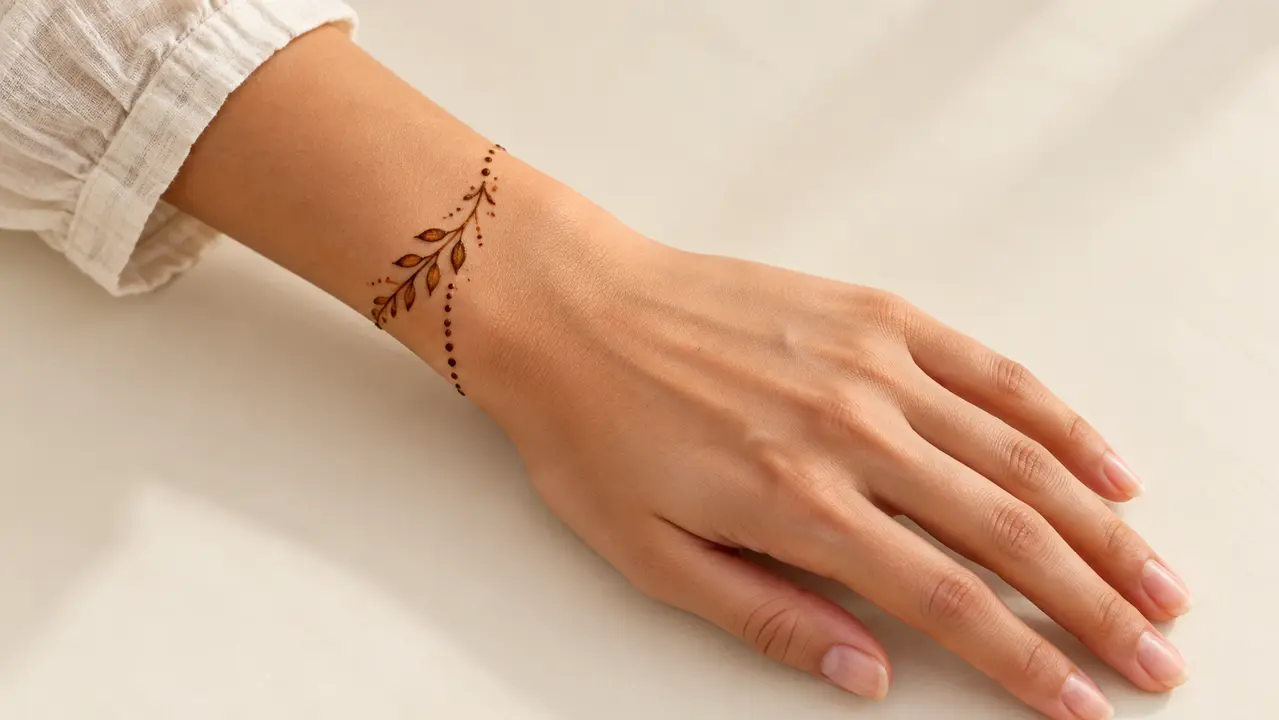
The Wrist: An Ideal Place for a Jewellery-Inspired Design
Henna on the wrist has an aesthetic advantage: a fairly simple composition can suggest a complete accessory. A few curves, dots or small leaves can be enough to evoke a bracelet. Unlike a large composition on the hand, the main idea is often to work with length and visual continuity.
The wrist, however, is not a perfectly flat surface. It bends, turns and changes appearance depending on the position of the arm. A design visible from the front can become partly hidden when you rotate your hand. So decide from the outset whether you want a motif mainly visible on top, a design on the side or an effect that truly wraps around the wrist.
A drawn-on bracelet does not need to close completely around the arm. A break can become a deliberate graphic choice: it can make the pattern look lighter and avoid the need for a strictly symmetrical circle.
Five Bracelet Styles for Five Different Effects
The chain of dots suggests a very delicate piece of jewellery. Small, spaced dots form a rhythmic line. You can place a slightly larger dot in the centre to draw the eye, like a pendant.
The leafy branch follows a gentle curve along the wrist. Two or three leaves are enough. The branch may be centred or placed to one side for a more natural result.
The double-line bracelet uses two parallel lines with a space between them. The challenge is less about drawing than keeping the distance consistent. A slight irregularity can create a handmade effect; too many breaks make the design look untidy.
The floral half-bracelet places a flower on the upper side of the wrist and leaves the sides more open. It is a good choice if you want to highlight a single shape rather than a complete border.
The graphic bracelet combines diamonds, triangles or chevrons. It looks more structured than leaves and curves. To avoid an overly heavy result, leave a visible gap between each motif.
The Best Placement Depends on the Effect You Want
A bracelet centred on top of the wrist is mainly visible when the palm faces down. A motif placed on the side is more noticeable during certain everyday movements. A composition that extends onto the forearm becomes more visible and gradually moves away from the “discreet bracelet” effect.
Scale also changes the character of the design. A line of small, widely spaced dots looks like a delicate chain. Bring the dots closer together and add a thick border, and it becomes a decorative band. Neither is superior, but they answer different preferences.
If you like wearing a watch or actual bracelets, notice where their straps and fastenings sit. A decoration in the area usually covered by your watch will be less visible. One option is to move the design a few centimetres towards the forearm or choose a border along the side.
Table: Find the Bracelet That Suits You
| You like… | Suggested style | Visual result | Avoid |
|---|---|---|---|
| Delicate jewellery | Visually connected dots | Light | Dots too close together |
| Botanical shapes | Branch and leaves | Flowing | Too many tiny leaf veins |
| Geometric lines | Double line | Clean | Lines merging |
| Flowers | Half-bracelet | Distinct centre | Flower lost in the border |
| Bold patterns | Diamonds and chevrons | Structured | An overly dense band |
When choosing, view the result from a normal distance: first with your arm resting on a table, then hanging by your side. A close-up image can make a minor irregularity appear much more important than it really is.
The Role of Empty Space in a Wrist Composition
Empty space is not a shortcoming. In a henna bracelet, it separates the motifs, makes them recognisable and sometimes suggests a finer piece of jewellery. If you fill every gap between two leaves, the style changes: a delicate branch becomes a continuous band.
You can create a simple hierarchy: one main element in the centre, two smaller echoes on the sides, followed by areas left clear. This arrangement helps the eye understand the motif instantly. On a narrow wrist, it can even look more elegant than a large, densely packed border.
Key point: decide first whether you want a “chain”, a “closed bracelet” or a “side decoration” effect. The shapes come afterwards. Starting with flowers without deciding on the type of bracelet often leads to adding details in an attempt to connect scattered elements.
Three Practical Scenarios to Consider Before Choosing
With a richly embellished party outfit, a small chain of dots at the wrist can add detail without competing with your jewellery. For a romantic look, a branch with a slightly off-centre flower can create a softer impression. For a modern aesthetic, two chevrons and an open space in the centre may be enough.
These are not rules about what to wear. Their purpose is to show how the design can interact with clothes and accessories. The very same bracelet can look quite different with a short sleeve, a long sleeve or a watch.
Finally, if you are considering a design that starts at the wrist and extends onto the back of the hand, treat it as a larger composition. The guide dedicated to the back of the hand will help you consider this continuity without turning this chapter into an application tutorial.
Frequently Asked Questions
Does a henna bracelet have to form a complete circle?
No. A partial border or open bracelet can look more delicate and is a legitimate aesthetic choice.
Can I wear a real bracelet with a henna design?
Yes, bearing in mind that jewellery may conceal part of the design. When choosing its placement, first look at where you usually wear your accessories.
Which style is most discreet on the wrist?
A chain made of a few dots or a fine branch placed to one side generally creates a light impression.
Is a geometric design necessarily more noticeable?
Not necessarily. Line thickness, spacing and the area filled matter more than the type of motif.
Explore More
- Explore henna patterns and inspiration
- Decorate fingers with a delicate touch
- Create a design for the hand
Sources and Methodology
- The Metropolitan Museum of Art — Woman Applying Henna: an example of historical documentation of henna practice, without claiming that the image validates contemporary designs.