
Minimalism Is Not Just About Drawing Small
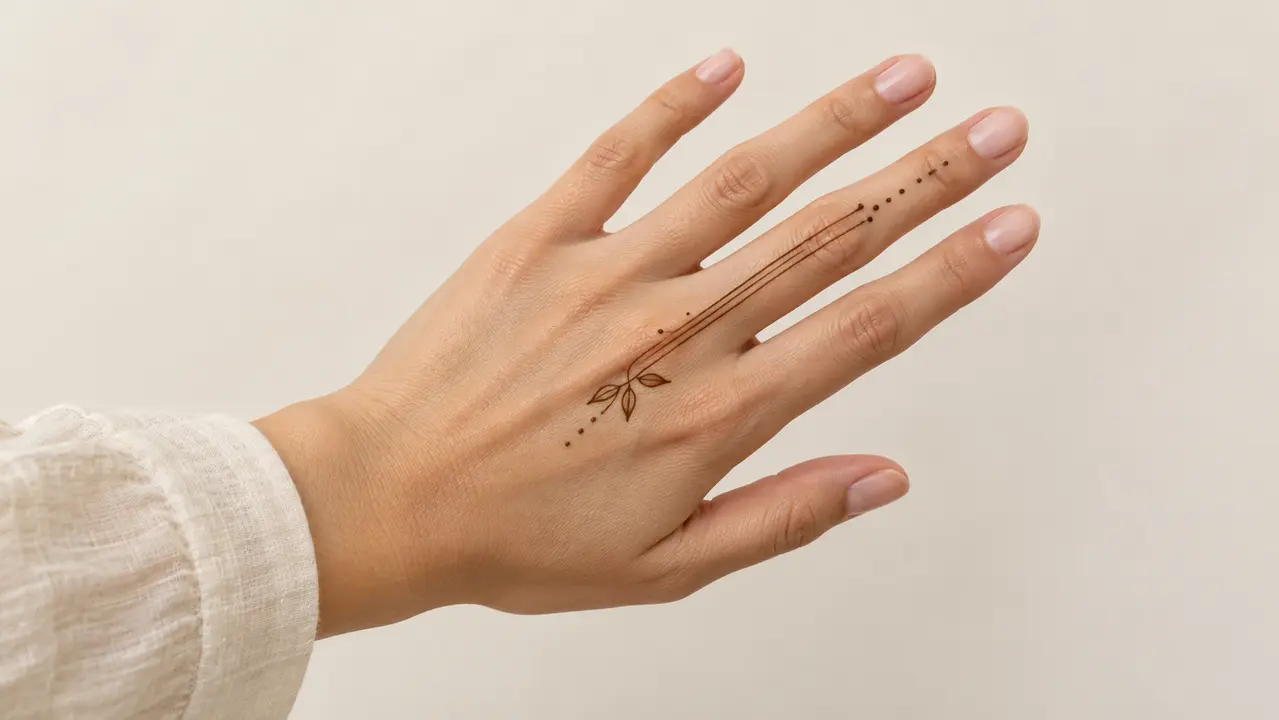
Minimalist henna is often associated with a tiny design near a finger. Yet size alone does not define this style. A long, fine line on the wrist can look more minimalist than a very small flower packed with details. The real common feature is selectivity: keeping a few strong shapes and removing those that do not serve the composition.
This approach can be very appealing if you like discreet jewellery, understated outfits or decorations that attract attention up close rather than from a distance. It also lets you explore henna without feeling as though you are wearing a spectacular design. But it requires some attention to legibility: a motif that is too fine may be difficult to see, particularly when photographed from a distance.
The idea, then, is not to make everything miniature. Rather, it is to understand why a line, a dot or a leaf can sometimes be enough to create a refined effect.
Five Principles of a Light, Coherent Design
A single focal point. Choose what the eye should see first. It could be a flower, diamond, small arc or a dot larger than the others. If every detail tries to draw attention, the design looks less calm.
Space around the elements. A small branch accompanied by two dots works because the skin remains visible between the elements. Space gives the shapes their importance.
Consistent line thickness. When lines suddenly vary in thickness for no visual reason, a delicate design can seem uneven rather than intentional. This does not mean everything must be identical, but that contrasts should support a deliberate choice.
A recognisable rhythm. Three spaced dots, two similar leaves or a series of small arcs are enough to create an organised motif.
Deliberate placement. A small centred element does not have the same effect as a detail on the side of the hand. Placement is an integral part of the design, not merely wherever space is left.
Six Ideas That Work Without Filled Areas
A small standalone flower on the back of the hand creates a gentle focal point. An open ring on a finger segment suggests jewellery without an accessory. A botanical line along the side of the wrist creates a discreet direction. Three dots beneath a nail draw the eye towards the fingers. A diamond with an open centre can produce a graphic effect. Finally, a delicate crescent near the base of the thumb adds an off-centre accent.
For each of these ideas, compare two versions: a very small design and a slightly larger one. You may find that the second retains its character better when the whole hand is viewed. A minimalist motif is not meant to become invisible. It should remain clear enough for its shape to be understood.
Avoid piling all these ideas onto the same hand simply because they are all small. Six discreet designs can eventually add up to a very busy composition. If you want a restrained result, choose one or two and save the others for another occasion.
Adapting This Style to an Outfit or Event
For everyday wear, a detail on one finger can complement a ring or manicure without drawing all the attention. For a celebration, a small branch on the wrist may be visible as you move your arm while remaining discreet at rest. With an elegant outfit featuring long sleeves, you might prefer a design on the back of the hand, where it will remain visible.
Minimalism is not reserved for everyday life, however. A bride may love delicate mehndi, just as someone with no special occasion may choose a dense composition. Personal tastes do not follow fixed rules. The most useful thing is to consider how the design works with your clothes, jewellery and the prominence you want to give it.
A simple way to assess an inspiration image is to display it at a small size on your phone. If you can no longer see the design at all, it may be too subtle for the effect you want. If you can immediately distinguish its silhouette, the design probably has a strong element.
Small Decision-Making Table
| You are looking for… | Idea | Expected effect | Check |
|---|---|---|---|
| A finger detail | Open ring | Drawn-on jewellery | Space between the arcs |
| Wrist decoration | Fine branch | Flowing line | Suitable length |
| An accent on the hand | Standalone flower | Gentle focal point | Clearly visible size |
| A very graphic design | Open-centred diamond | Structure | Clean outline |
| An almost secret decoration | Three dots | Discreet rhythm | Spacing |
This table does not establish an aesthetic ranking. It helps connect a specific wish to a simple shape. You can then change the scale and placement without losing the minimalist spirit.
What to Avoid in Online Inspiration
Heavily retouched photographs can make extremely fine lines look sharper than they will in real life. Some designs have also been enlarged on screen, creating a misleading impression of precision. A photograph showing only one centimetre of skin cannot convey the overall balance of the hand.
When choosing, ask yourself three questions: can I understand the silhouette of the design? Do I like its placement when I see the whole hand? Could I remove a detail without destroying the idea? These questions will help more than an endless gallery.
Key point: minimalist henna is not “less successful” mehndi. It is another way of composing: fewer elements, more space and particular attention to the position of every stroke. If this style appeals to you, explore the specialist guides on fingers and wrists to find the ideal placement.
Frequently Asked Questions
Does a minimalist design have to be very small?
No. Minimalism is primarily about the number of elements and the clarity of the composition, not just its dimensions.
Can minimalist henna be combined with jewellery?
Yes. Simply check that the design remains visible and complements the accessories without creating an overly busy effect.
What is the difference between a minimalist and an easy design?
An easy design is intended to be simple to create. A minimalist design primarily seeks a clean visual effect; the two can overlap without being the same thing.
Is it suitable for a ceremony?
Yes. A celebration does not require a dense composition. The choice depends on your preferences and personal circumstances.
Explore More
Sources and Methodology
- The Metropolitan Museum of Art — Woman Applying Henna: an example of historical documentation of henna practice, without claiming that the image validates contemporary designs.