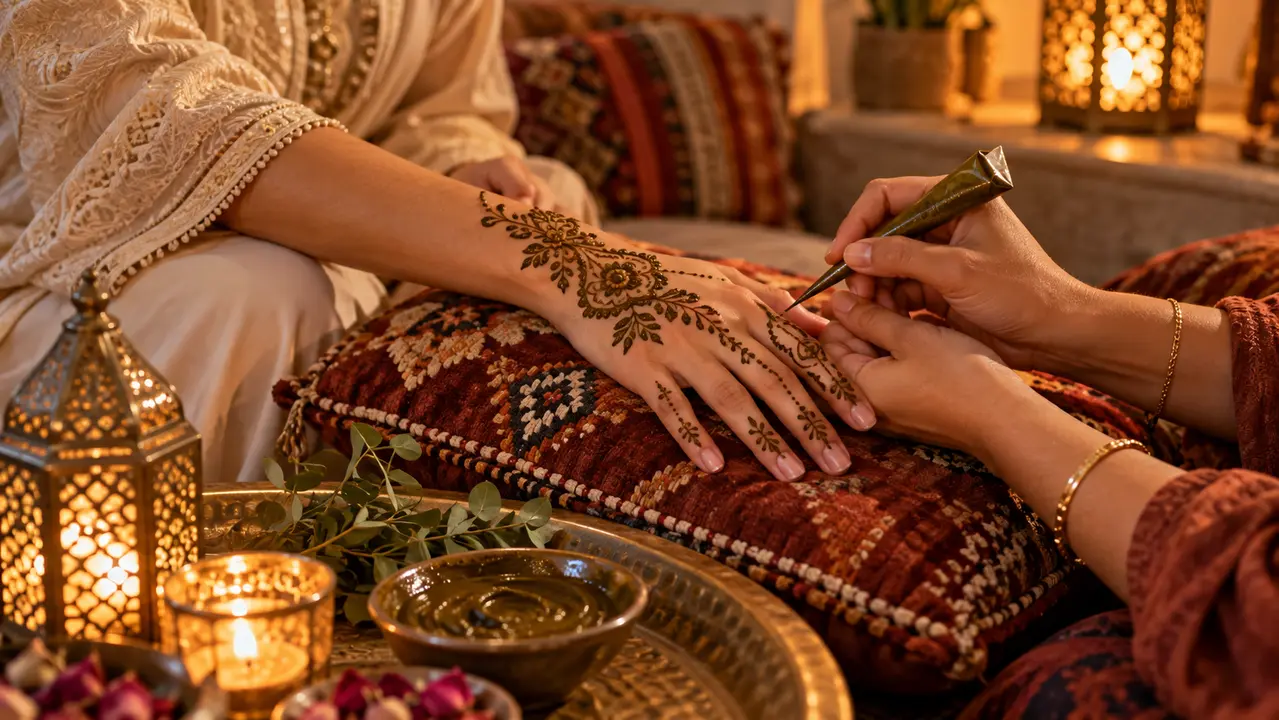
You may have read that a henna flower always symbolises love or that a circle promises a particular kind of good fortune. Such explanations are appealing, but symbolism varies across traditions and individuals.
A Shape Has No Universal Meaning
The same flower might be chosen for its elegance, because of a family custom, or simply because the artist draws it well. Without context, we cannot infer its meaning.
Distinguishing Symbolism from Decoration
Some designs are associated with documented social practices; others are primarily decorative. The difference cannot be determined by counting petals, but by understanding who uses the design and in what circumstances.
Asking the Right Questions
If someone presents a particular symbol to you, ask which region or community the interpretation comes from, and whether it is passed down in a specific context. A local source is more useful than a chart claiming universal meanings.
Creating a Personal Design Without Inventing a Story
You can give a design a meaning of your own, such as commemorating an event. If you do, present it as personal symbolism rather than a tradition shared by everyone.
How to Check a Claimed Symbolic Meaning
When an image claims that a flower, triangle or spiral always means “love”, “wealth” or “protection”, ask three questions: who gives it that interpretation, in which community and during which period? The same motif may be purely decorative in one family and have particular significance in another. Without an identifiable source, describe it as a graphic element rather than a universal symbol. This does not diminish its beauty; it simply prevents an inspiration from becoming a false cultural rule.
Why Lists of Symbols Are Often Misleading
You may have read that a flower invariably represents love, a diamond guarantees protection or a spiral brings luck. These interpretations spread easily because they are simple to share. But a design does not automatically mean the same thing in every region, every era and to every person. Even when a symbol has a documented interpretation in a particular context, that does not make it a universal law.
A more reliable approach is to ask: who assigns this meaning? where? on what occasion? in which source? Without those four elements, it is better to say that a motif may be interpreted in a certain way than to claim that it always means something.
Three Levels of Meaning That Should Not Be Confused
First: the meaning assigned by the person wearing the design. A flower might remind them of a friend, a date or simply a style they like. Second: a meaning shared within a family or community. Certain gestures and decorations may accompany a particular celebration. Third: an interpretation published in a book, museum or research study. A source may document a practice in a specific setting, but its context must be preserved.
These levels do not cancel one another out. A motif may have a shared history yet be chosen today for purely aesthetic reasons. Problems arise when personal preferences are confused with documented traditions.
A Practical Example: One Flower, Three Possible Interpretations
One reader chooses a small flower because she finds it delicate. Another wears a floral design associated with a celebration in her family. A third adopts a composition she has seen in the work of a contemporary artist. The motifs may look alike, but the intentions differ. It would therefore be wrong to infer a single meaning from the photograph alone.
The same applies to geometric compositions. A repeated shape may help balance a design or fill part of the hand. It may also have significance in a particular context. Without documentation, a visual explanation is the safest approach.
How to Verify a Claim Found Online
Start by tracing the text back to its source. Is it a signed publication, a first-hand account grounded in a particular place, or an anonymous caption repeated across multiple accounts? Then check whether the source actually concerns henna, the country and the period in question. A book on a region's textiles does not, by itself, prove that an identical motif carries exactly the same meaning on the skin.
Finally, compare the wording. “Some people associate this shape with...” is a limited claim that may be supported by evidence; “Since time immemorial, all women...” is a generalisation requiring exceptionally strong proof. A good article prefers an accurate qualification to an invented certainty.
How to Create a Personal Composition
You can create a design that reflects who you are without inventing an ancestral meaning for it. Choose a shape you like, a place on the hand and a balance between lines and negative space. If you want to evoke a memory, say so simply: “I chose this branch to remind me of a journey.” The explanation is personal, clear and honest.
An educational image should help people observe, not manufacture beliefs.
Frequently Asked Questions
Does a flower always mean the same thing?
No. Its meaning, if it has one, depends on the context.
Can you create a personal symbol?
Yes, as long as you make clear that it is your interpretation.
Are online charts of symbols reliable?
Not necessarily. Check the sources and cultural context.
Henna and Muslim Traditions: An Important Place, but Varied Practices
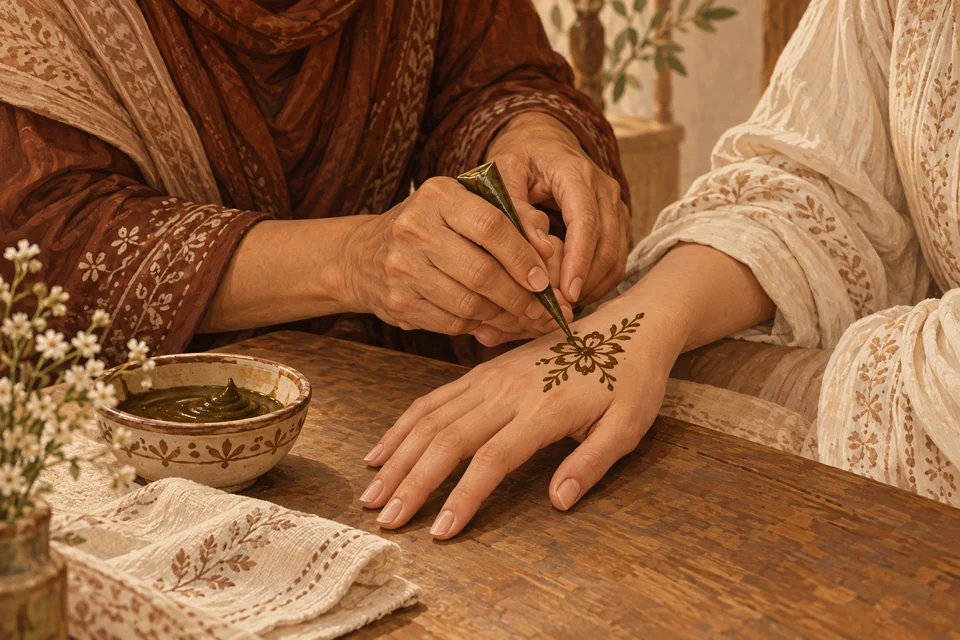
In many Muslim families, henna accompanies happy occasions: weddings, family gatherings and celebrations. For some people, it brings back childhood memories, a celebration prepared with loved ones or a skill passed down through generations. But its place in family life does not mean that the same design carries a precise religious meaning everywhere.
That distinction matters. A flower drawn on the hand may simply be chosen because it is beautiful. Another family may associate it with a memory or a symbolic value. There is not necessarily a common rule linking these two situations. The meaning given to a design often depends on context, country, region and family history.
In 2024, UNESCO recognised social and aesthetic practices associated with henna in sixteen countries in North Africa and the Middle East. This recognition highlights the transmission of skills, the importance of festivities and connections between generations. It does not say that every pattern is a religious prescription or that it must be worn for a particular celebration.
Custom, aesthetics and religious practice: three different questions
When a reader asks, “Is henna a Muslim tradition?”, they may actually be asking several different things. They may want to know whether henna is found in Muslim-majority societies, whether it accompanies certain celebrations, or whether religious rules govern its use. These questions do not have the same answers.
On Hennediscount, we can describe observed practices, aesthetic styles and documented traditions. For discussions of religious legal sources, it is better to direct readers to a resource specifically designed to distinguish texts, opinions and interpretations, rather than inventing a simplified ruling in a beauty article.
The question of ablution often comes up
Some women wonder about henna staining left on their skin or nails and its relationship to ablution. A central issue is the difference between colour remaining after the paste has been removed and a layer of material that prevents water from reaching the relevant area. Islamic legal opinions must be read in context; a marketing term such as “natural” or “halal” is not enough to reach a conclusion.
Key point: henna can be a decorative art, a family custom and part of a celebration. Avoid turning a regional custom into a universal rule or religious obligation.
Do all henna patterns have a religious meaning? No. A pattern may be purely decorative or have personal or cultural significance. Automatically assigning a religious meaning to every flower, leaf or arabesque would be misleading.
Sources and References
- UNESCO, 2024 inscription decision: https://ich.unesco.org/en/decisions/19.COM/7.B.15 (scope: social practices and their diversity across the 16 participating States, not local details)
- UNESCO, nomination file and community testimonies: https://ich.unesco.org/en/RL/henna-rituals-aesthetic-and-social-practices-02116 (consult country-specific documents before making any local claims)
- https://ich.unesco.org/fr/RL/le-henne-rituels-pratiques-esthetiques-et-sociales-02116
- UNESCO — Henna: rituals, aesthetic and social practices (2024): https://ich.unesco.org/fr/RL/le-henne-rituels-esthetique-et-pratiques-sociales-02116